May and the Indians
Women born into families of average means in rural New England in the
late-1800s, had little prospect of realising dreams of university education,
international travel and the sort of common bonding with the larger world
that many of us take for granted today. Nonetheless many still had the desire to learn about the world
in whatever way they could. Aunt
May was a woman of strong and intense intellect with many dreams and yearnings
inside of her to see over and beyond the horizons of the world she was born
into. It was this yearning that
led her to travel across the northeast USA and southeast Canada hiking the
trails, canoeing the rivers and watching her beloved birds.
However
May had bigger ambitions. Most would remain only far away dreams,
but this never stopped her from dreaming anyway. This is the story of the one trip in May's life, which would
take her far beyond the boundaries of her usual stomping grounds. This is her trip to the Navajo Reservation
of Arizona and New Mexico.
Now
the story of May and the Navajos is as colourful and sweet as May herself. It
all started in 1946 while she was watching the film newsreels in the Gloversville
theatre about Mahatma Ghandi and his struggle to liberate India.
May was totally swept away by Ghandi, his manner and philosophy. To
most Christians the trinity consisted of the Father,Son and the Holy Ghost.
To May, however, it consisted of Jesus Christ, Eleanor Roosevelt and Mahatma
Ghandi.
After
seeing all these newsreels May got it into her head that she had to go to
India to help Ghandi. Day and my grandfather snickered as usual putting this
up as another one of May's strange and crazy whims. But for whatever reason
May was deadly serious more so than ever before. Years of longing to see the
world and being a part of the bigger events that moved humanity had welled
up inside her, and the dam was ready to burst.
May
would not let up on this issue, and started to buy every book about India,
make arrangements, and reserve passage.
She even asked my grandfather if he would go if Day wouldn't.
Having
talked to May at length about this time, I am not sure if she really thought
she could get away with this or if she was grasping at straws seeing what
would happen when the smoke cleared. She told me that she was really to scared
to actually go off so far away. But that she was searching for something,
and she had to find it anyway she could. May told me that she was sick of
watching the world pass by while cold, rich businessmen in dark suits made
all the decisions. World War II had made her very sad about humanity in general.
She was always a fan of Montana's lone representative, Jeanette Rankin.
Now here was Ghandi, a poor and wise man trying to save his country,
and he surely needed May's help. In
her heart she really wanted to go and do what she could, but she really didn't
know what she could do.
Now Day always calm and circumspect
began to panic a bit. He might envision making a month long visit to Ohio to
visit relatives for a week, but to India for several months, not hardly. He realised that May had been going
through a hard and frustrating time after the war, and he knew that she was
gutsy enough to try and head off.
Anyway
the issue continued to boil away and each new newsreel from the Subcontinent
only fuelled the fire. Now May became increasingly despondent
and agitated, so Day took it upon himself to find a solution. He discovered a program where people could
sponsor children on the Navajo Indian Reservation. He sponsored two young boys under this
program. He figured that Indians
were Indians and if May couldn't help Ghandi in the Subcontinent at least
she could help the Navajos.
Shortly
afterwards the two small boys, their mother and teacher sent letters and pictures
to May. The letters told about life on the reservation,
about the canyons and weather. Immediately upon viewing the pictures and reading the notes,
May threw herself into her new cause.
She wrote a note to them asking about their lives and also about what
birds were there. The youngest
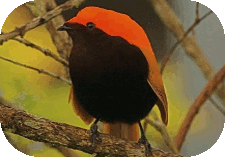
boy who was about 7 drew her a picture of bird that looked like a cross between
a Vermillion Flycatcher and an Emperor Penguin, anyway it was a big red bird
of some kind. This picture, of course, went straight to May's heart, and she
was caught, hook line and sinker.
May and Day never had any children of
their own, and thus May was all excited about her young, new friends in
Arizona. And anyway Ghandi had managed to free India in August 1947, so May
felt the burden lifted. Now before long May was busily corresponding with any
Navajo who would or could write to her. She learned all about the canyon lands,
the birds and the rocks. She
wanted to learn the Navajo language as well. So many people sent her lists of
English words with Navajo translations. She was appalled to learn that the
Navajo were not encouraged to keep their own language and were banned from
using it in the reservation schools. She was determined to reverse this
terrible trend.
She
started sending all kinds of things out to the reservation, and people in
turn sent her small souvenirs of beads, pressed flowers and bird feathers. Day
was very happy to see May back in her element. However, May was not content with correspondence.
She now decided that she would visit the reservation at all costs,
meet her newfound friends and for once see a new part of the world.
Now
Day could get away with denying her a trip to India proper, but there was
no way he could deny her this. After May talked my grandparents into going
as well, Day finally relented and the die was cast. My grandfather who never
read anything in life but Zane Grey novels was quite excited about seeing
the Wild West. Thus plans were made,
suitcases packed and in May 1949 the car rolled out the garage door destination
Kayenta, Arizona.
Now
May was going to use this trip to see the many places and birds that she had
always dreamed of seeing. She kept a wonderful diary, which is always
a joy to read. The first places that
May wanted to see were Long Point and Point Pelee on the north shore of Lake
Erie. These were known as particularly
good birding areas. Long Point seemed to pass without incident. But her entry
for Point Pelee is very amusing.
"We
went for a walk to an area of tidal swamp.
Cuckoos of both bill colors are easily seen. Also excellent views of
Black Terns and Least Bitterns. The terns are very elegant and fly in amazing
patterns. When we returned, we noticed somebody in our tent.
To our amazement that somebody was a giant raccoon nearly as big as
Day (and that's big). He had one of Day's chocolate bars in his hand and seems
pleased as pie with his find. Day is disgusted. Never have seen so big a raccoon
in all my born days. Not only
are the racoons bigger here than in New York, but there are so many more mosquitoes.
A deer passed right in front of us and didn't even notice us, he had so many
skeeters on him--poor fellow! The boys (Day and Frank) spent the evening cussing
both the raccoons and the skeeters. They tried to fish but didn't catch anything but mosquito bites.
Alice made her famous buckwheat pancakes over the fire. What a great adventure! May 27, 1949.
The next days they past Detroit and
crossed southern Michigan camping near the town of Allegan where May noted the
great abundance of Red Headed Woodpeckers and Cerulean Warblers.
Day
convinced everyone that they had to visit and stay in Chicago a few days.
If Day had to fight with giant mosquitoes and raccoons at least he
was going to get a few days of hotels and soft beds. May notes that Chicago "is ugly with lots of fat pigeons".
From
Chicago it was a beeline for Hannibal, Missouri. The thoughts of Mark Twain,
River Boats and the ole Mississippi caught all their imaginations. May writes "Frank is just like a school boy. He can't
wait to cross the Mississippi so he can say he is in the Wild West. I keep
telling him that Hannibal, Missouri is not very wild or very west, but he
seems to think its close enough. Hooded
Warblers are all about." Hannibal,
Missouri proved interesting to everybody and brought May her first Blue Grosbeak.
"What I thought was a particularly fat Indigo Bunting, turns out to be
a Blue Grosbeak. Very interesting,
but doesn't sit still for a long enough look. Thunder storms on the horizon".
Here
ends Part I of May's journey west.